
#LCSM Chat Topic 9/7: Doing Cancer When You Have Kids

Original Photo by Unknown Author and this modified image are licensed under CC BY
Although the average age for a lung cancer diagnosis is around 70 years old, an increasing number of younger patients are being diagnosed. Many of these younger patients have especially aggressive cancer, and have children at home. The patient or their spouse/partner may be uncertain about when and how to tell their child about cancer, and struggle with finding supports that help the children process the situation.
On September 7 at 8 pm Eastern Daylight Time (5 pm Pacific), #LCSM Chat will discuss the special situations that arise in families when the parent is diagnosed with lung cancer and has younger children. Moderator Janet Freeman-Daily (@JFreemanDaily) will lead our chat using the following topic questions:
- T1: At what point in the process of cancer diagnosis and treatment should a child be told about a parent’s cancer?
- T2: How should the child’s age, temperament, or other characteristics influence what the parent says about cancer?
- T3: Should children ever talk to their parent’s cancer doc or visit the clinic? How can healthcare providers help children cope?
- T4: What resources are available for children of cancer patients? What programs exist? What activities help?
- T5: If you know a child whose parent has cancer, how can you best support the child?
We look forward to seeing you in our September 7 #LCSM Chat. If you’re new to tweet chats, check out this handy primer.
Resources:
- Talking to Kids & Teens About Cancer (Cancer Support Community)
- How should children be told that a parent has cancer? (American Cancer Society)
- Helping Children When a Family Member Has Cancer (CancerCare)
- Talking With Your Children (Cancer.Net, the patient page of ASCO)
- Talking With Your Teenager (Cancer.Net)
- Talking to Children about Your Cancer (National Cancer Institute)
- How to Tell Your Children about Your Cancer Diagnosis (National Comprehensive Cancer Network)
- Camp Kesem (for children whose parents have cancer)
#LCSM Chat Topic August 10: The Ins and Outs of Lung Cancer Biopsies
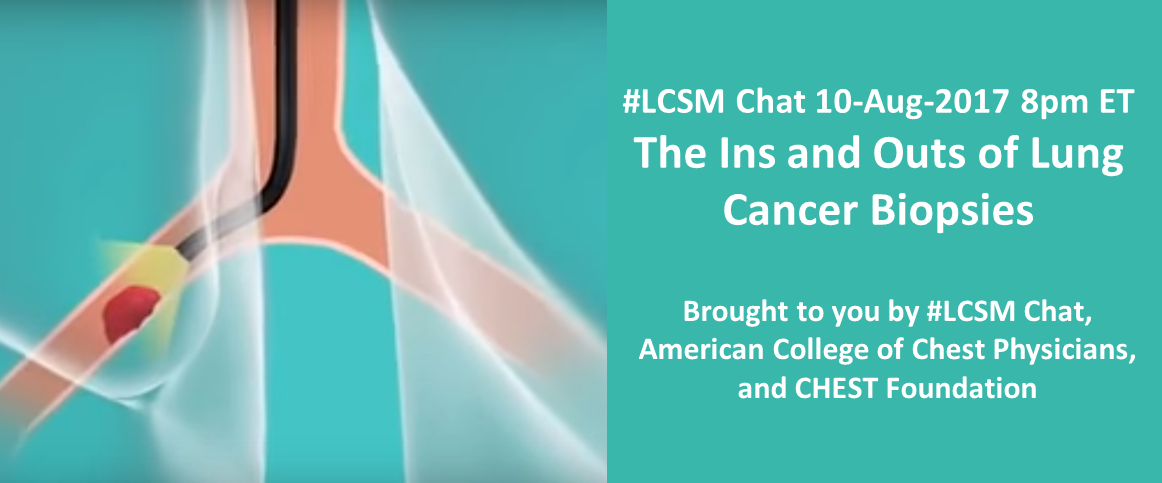
For theAugust 10, 2017 chat at 8 PM ET, #LCSM Chat is partnering with the American College of Chest Physicians and CHEST Foundation to discuss lung cancer biopsies. We’re excited to see what this partnership will bring to the chat!
Biopsies are an important part of the diagnostic process for lung cancer. A biopsy collects a specimen such as tumor tissue, or fluid from the space around your lungs. The specimen is then analyzed to determine if any cancer cells are present. If so, the cells are tested to help identify the type of cancer. Cancer cells obtained in biopsies can also undergo molecular testing to determine what type of treatment—such as a targeted therapy or immunotherapy–might be most effective.
Several different procedures are used to collect biopsy specimens for diagnosing and treating lung cancer:
- Bronchoscopy
- Endobronchial ultrasound
- Fine needle aspiration
- Core needle biopsy
- Surgical lung biopsy
- Thoracentesis
Each of these procedures have benefits and drawbacks: some are less invasive, others can better access tumors in certain areas of the chest. Yet others may be better at obtaining sufficient tissue for molecular testing, which may be necessary to enable the patient to take a targeted therapy or immunotherapy that has fewer side effects with a better chance of managing the cancer.
Our chat will talk about the use of biopsies, pros and cons of different biopsy procedures, and factors patients and their healthcare team should consider when choosing the best biopsy for a given patient. Moderator Janet Freeman-Daily (@JFreemanDaily) will lead our chat using the following topic questions:
- T1: What is a biopsy, and how is it used in diagnosing #lungcancer?
- T2: What biopsy procedures are used in diagnosing/treating #lungcancer?
- T3: When might biopsies be necessary during or after #lungcancer treatment?
- T4: How do biopsies enable patients to access newer treatments such as targeted therapies and immunotherapies?
- T5: What factors should healthcare providers and patients consider when selecting the best type of biopsy for their case?
If you’re new to tweet chats, check out this handy primer.
#LCSM Chat topic 7/27: Happy birthday #LCSM–four and feisty!

Please join the #LCSM Chat on Thursday, July 27, at 8 pm Eastern Time (5 pm Pacific) to celebrate our fourth birthday.
First, a little history….the #LCSM hashtag was originally used by @subatomicdoc (Matt Katz, MD) to represent Lung Cancer Social Media on June 22, 2013. The first-ever #LCSM Chat occurred on July 25, 2013. Seventy-two patients, advocates, caregivers, family members, educators, healthcare providers, and researchers participated. The first #LCSM Chat topic question was “It’s our community. What do you hope to get out of #lcsm chat?” The answers were diverse and wide-ranging, reflecting the interests of a broad-based lung cancer community. Most importantly, this platform was a revelation—no other forum allowed all stakeholders in the lung cancer community to communicate directly with each other.
Since that time #LCSM has come a long way. During the past year, the #LCSM hashtag was used in almost 99,000 tweets from 13,227 participants and generated over 416 million impressions! We’ve chatted about wide ranging subjects as direct to consumer advertising in lung cancer, the best tools for online cancer education, why multidisciplinary tumor boards are important, and dealing with grief over cumulative losses in the lung cancer community. We conducted a Facebook Live Q&A on immunotherapy and clinical trials jointly with the National Cancer Institute, a second Facebook Live event What I Like About the IASLC World Conference on Lung Cancer, and “open mic” nights to hear about what is important to all of you. Throughout all of this, our mission has remained the same: to use social media in an innovative manner to educate, develop public support, end the stigma, and facilitate successful treatments for the leading cause of cancer deaths worldwide.
To celebrate our fourth birthday, moderator @JFreemanDaily will lead the #LCSM Chat in discussion of the following topics. We’re hoping to compare the answers from this year’s birthday chat to those of last year to see how #LCSM is evolving in the eyes of community members.
- T1: How has #LCSM affected your understanding of #LungCancer?
- T2: How well did #LCSM help to disseminate the most important #lungcancer news and events in the past year?
- T3: How could #LCSM better increase #LungCancer awareness, advocacy, and research funding?
- T4: How might #LCSM partner with other groups or social media stakeholders for future events?
- T5: Should #LCSM Chat expand to use other platforms besides Twitter? If so, which one(s)?
Please remember to include #LCSM in ALL your tweets so the other chat participants can see them. You can read a primer on participating in the chat here. Hope you’ll join us to celebrate the fourth birthday of Lung Cancer Social Media!
 #LCSM
#LCSM 
You must be logged in to post a comment.