
#LCSM Chat Topic 11/30: Expanding the web of knowledge in #lungcancer

We end lung cancer awareness month with a very interesting topic. The next #LCSM Tweet Chat on Thursday, November 30th at 5 PM Pacific/ 8 PM Eastern will discuss “Expanding the web of knowledge in #lungcancer.” The moderator for this chat is Dr. David Tom Cooke (@DavidCookeMD).
There is a vast amount of information on the optimal treatments and approaches to beat lung cancer. Whether it is lung cancer screening, surgery for early stage disease, SBRT for patients with early stage disease who are not candidates for surgery, the importance of molecular testing for tumors, opportunities for immunotherapy for advanced tumors, and the benefits of clinical trials; there is important information that must be spread or disseminated to patients, their families and healthcare providers.
Yet despite the readily available evidence based information, >80% of Americans are unaware that screening for lung cancer is recommended and covered by insurance at no cost for people who are at the highest risk (American Lung Association Lung Health Barometer). In addition, <5% of adult cancer patients enroll in cancer clinical trials (Murthy VH, et al. JAMA. 2004)
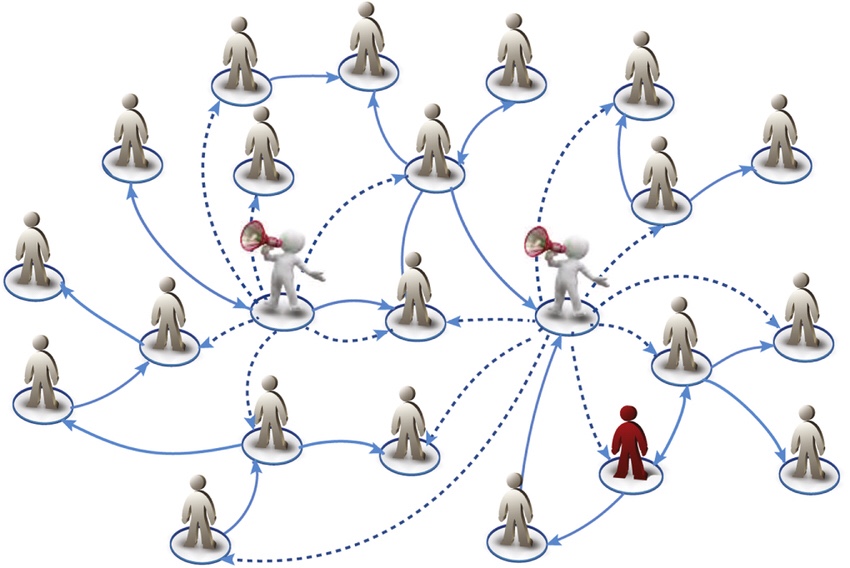
#LCSM and social media has prided itself as a method of disseminating quality, evidenced based information to the lung cancer community. This of course involves our tweet chats, but also our web page and Where to Find Trusted Lung Cancer Info tab. However social media has its strengths and weakness in reaching all stakeholders. For example only 34% of people 65 and older visit at least one social media site a year. Women use social media more than men (72% compared to 66%), Whites and Hispanics more than Blacks (64% and 79% compared to 63%) and social media reaches only 60% of rural Americans.
On Thursday, November 30th, we hope to discuss what are good and not so good ways to disseminate lung cancer screening, diagnosis and treatment best practices? Also during the process, perhaps we can generate new and innovative ideas!
With the above goals, here are questions that will be discussed during our November 30th Tweet Chat:
T1 What are the strengths of social media in spreading info about best and newer treatments of #lungcancer to patients?
T2 What are the weaknesses of social media in spreading info about best and newer treatments of #lungcancer to patients?
T3 What about doctors, care providers and hospital administrators in smaller community settings? What is best way to disseminate up to date information?
T4 Should our approach change to disseminate #lungcancer information to patients in #rural communities? What approaches might work the best to reach rural America?
T5 How do we measure the effectiveness of interventions for spreading information?
T6 What effective methods have you seen for spreading information about #lungcancer or other #cancers? Why are they effective?
Please remember to include #LCSM in ALL your tweets so the other chat participants can see them. You can read a primer on participating in the chat here. Hope you’ll join us!
#LCSM Chat topic 11/16: Running on Empty—Advocacy and Burnout

It’s Lung Cancer Awareness Month, when lung cancer patient advocates knock themselves out sharing information and factoids about their disease. However, you know you spend too much time as a cancer patient/advocate when …
- You think you see a cancer ribbon on your driveway, which upon closer inspection is actually a drowned earthworm.
- Most of your travel revolves around cancer.
- You lecture strangers on the street about lung cancer stigma.
- You know enough people who have died to easily post one per day for a month.
As research develops more effective cancer treatments , the number of cancer patient advocates and survivors (including those living with metastatic cancer) is growing. Some of us have been at it for years. We feel an urgency to promote awareness, educate patients and carers about treatments, share our experiences, and obtain more research funding so we can help save lives of current and future patients, and perhaps even our own. We can’t stop, because we don’t want to see cancer claim another life and devastate another family.
And yet, there is a limit to our energies and abilities. We advocates are human, and in some cases humans in active grieving or cancer treatment. Much as we would like to be superhuman, cancer patient advocates can’t do everything.
Sometimes we become overwhelmed (or even depressed) by the magnitude of the task ahead of us, by our seeming inability to accelerate research or save every cancer patient we encounter. Sometimes we must fend off anger directed at us by those in pain, while still maintaining compassion. Sometimes our health suffers from the stress and long hours. Sometimes we wonder whether we’re truly enjoying our limited time on earth. Sometimes all this make us less effective as advocates–it’s hard to give good energy to others when your own cup is empty.
Sometimes we just need to take a break from cancer patient advocacy to recharge.
On November 16, 2017, at 8 PM New York Time (5 PM Seattle time), our #LCSM community will explore this issue in an hour-long chat titled “Running on Empty—Advocacy and Burnout.” Moderator Janet Freeman-Daily (@JFreemanDaily) will lead our discussion using the following questions:
- T1: What do you do as a cancer patient advocate, and how long have you been doing it? (Note: a cancer patient advocate can be anyone who advocates for cancer patients).
- T2: What events or situations in your advocacy work have caused you the most stress and/or distress? How do you cope with them in real time?
- T3: Have you ever considered quitting your advocacy work? If you continued your patient advocacy work after that point, what persuaded you to continue?
- T4: What steps have you taken to help you recharge your advocacy energies? If you take took a break from advocacy, how long was the break and what did you do during the break?
- T5: Based on your experiences as a cancer patient advocate, what advice would you offer to those who are considering becoming cancer patient advocates to ease their way?
This is the first chat in which tweets can be 280 characters–make good use of them! Please remember to include #LCSM in ALL your tweets so the other chat participants can see them. You can read a primer on participating in the chat here. Hope you’ll join us!
#LCSM Chat Topic 11/2: What Was Your Favorite #LCSM Chat, and Why?

We are excited to kick off Lung Cancer Awareness Month with an awesome topic. The next #LCSM Tweet Chat on Thursday, November 2nd at 5 PM Pacific/ 8 PM Eastern is “What Was Your Favorite #LCSM Chat, and Why?” The moderator for this chat is Dr. David Tom Cooke (@DavidCookeMD)
From July 25, 2013, our inaugural Chat, to September 7, 2017, we have hosted 102 Tweet Chats. Using Symplur Signals (Symplur LLC, Los Angeles, CA) we were able to do a deep dive into the analytics of those chats. During those 102 chats, there were 58,010 total tweets, 5,595 participants, and 183 million impressions. The majority of folks who participated in the chats were identified as patients (23%), with doctors and healthcare providers making up 21% and caregiver/advocates 11% (Figure).
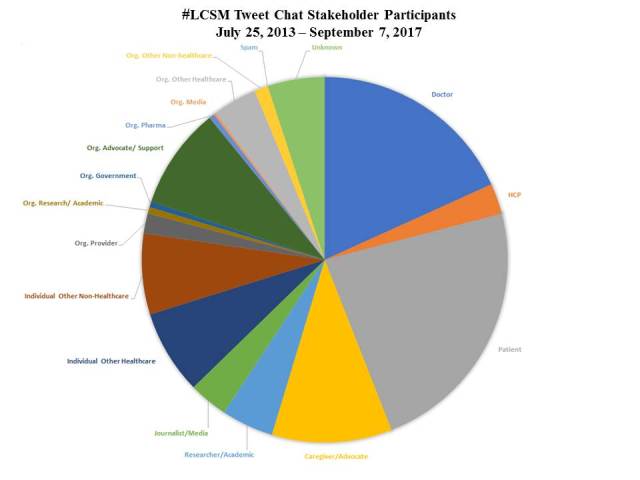
The top chat for patients based on the percentage of participants was June 1, 2017, “Community Grief-Dealing with our Cumulative Losses” (45%). For caregivers/advocates the top chat was December 4, 2014 “CMS Lung Cancer Screening Rules: Overboard, or On the Mark?” (20%). Finally, for doctors/healthcare providers the top chat was September 17, 2015, “Surgery or Radiation for Early Staged, Operable Lung Cancer: Which Road Should I Take?” (62%).
On Thursday, November 2nd, we hope to learn what moves our wonderful #LCSM tribe; which chats motivated you the most to take time out of your busy day (or evening!), to stick your toe into and contribute to the conversation?
To assist with the conversation, a complete list of #LCSM Tweet Chats can be found here. With the above goals, here are questions that will be discussed during our November 2nd Tweet Chat:
T1 What was your favorite #LCSM Tweet Chat, and Why?
T2 Patients participated most in “Comm Grief-Dealing w/ our Cumulative Losses”. Why would that chat resonate the most? #LCSM
T3 Caregivers/Advocates participated most “@CMSGov #LungCancer Screening Rules”. Would this still be the biggest advocate focus? #LCSM
T4 Docs participated most “#Surgery/Radiation Early Staged #LungCancer: Which Road?” Is there an understanding gap in #LCSM for early stage?
T5 Which chat, if any, missed the mark? Why? #LCSM
T6 Moving forward, what Chat Topic do we need to pursue? #LCSM
Please remember to include #LCSM in ALL your tweets so the other chat participants can see them. You can read a primer on participating in the chat here. Hope you’ll join us!
 #LCSM
#LCSM 
You must be logged in to post a comment.